
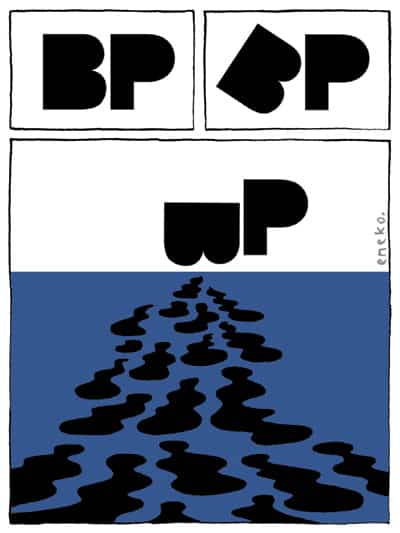
Responding to questions from Democratic Congress member Ed Markey regarding the oil leak in the Gulf of Mexico, Purdue professor Steve Wereley stated there were no possible scenarios in which BP's original estimate of 5000 barrels of oil leaked a day (a claim they have since been forced to withdraw) is credible. Instead, preliminary estimates from independent scientists run as high as 95,000 barrels of oil per day.
In an interview on Democracy Now! on Friday, Alaskan marine biologist Rick Steiner offered the following appraisal: "[T]his thing really brings home the true costs of oil—you know, the environmental costs of spills and the healthcare costs of breathing the atmospheric pollution, the wars to secure oil supplies, climate change, etc. So we need to use this event to catalyze a rapid transition to sustainable energy. A number of us had hoped Exxon Valdez would do that years ago. It didn’t. All we got out of that was safer tankers. Here, if the only thing we get out of the Deepwater Horizon is safer offshore drilling rigs, we’ve missed another golden opportunity."
Initial polls show that the Left has some space to maneuver on this issue. According to a May 11 poll by The Pew Research Center for the People & the Press, 92% of the population view the spill as at least a serious problem (55% think it's a major environmental disaster). Only 33% rate the federal government's response as good or excellent. 36% believe Obama did all he could. Pew notes: "The spill also appears to have taken a toll on support for offshore drilling near the United States. Currently, 54% say they favor allowing more offshore drilling for oil and gas in U.S. waters, which is down from 63% in early February and 68% in April 2009." The fact that a majority of the population support off-shore drilling in the immediate wake of an enormous oil spill illustrates the failure of the environmental movement to build a broad base in the US. Bizarrely, the report also found: "There also is slightly less support for increasing federal funding for research on wind, solar and hydrogen technology than there was in February (73% today, 78% then). About two-thirds (65%) favor spending more on subway, rail and transit systems, compared with 70% in February. About half (45%) favor promoting the increased use of nuclear power, down slightly from 52% earlier this year."
Considering the Obama administration's "lackadaisical" and "naive" response (if I may appropriate the words of moderate Democratic strategist James Carville), in the event of inadequate mobilization and pressure on the administration from the Left, Deepwater Horizon will certainly be another Exxon Valdez.
(Cartoon by Eneko Las Heras, a cartoonist from Caracas, Venezeula. For more, see his blog: . . . Y sin embargo se mueve)

3 comments:
http://bimchat.wordpress.com/2010/05/06/deepwater-gulf-oil-spill-will-bp-take-nuclear-option/
Russia has an old-fashioned and highly effective option for sealing oil leaks. Alexander Moskalenko, head of GCE, a Russian oil consultancy, tells the Moscow Times an underwater nuclear explosion could be used to bury the leaking oil well. The suggestion is not as bonkers as it sounds.
According to the Russian newspaper Komsomol Pravda, the Soviet Union used the method five times to seal off hydrocarbon spillages. The first time was in 1966, near Bukhara in Uzbekistan, when a 30-kiloton atom bomb was used to blow out and seal a burning gas well. (The bomb used in Hiroshima was 20 kilotons.)
The idea is simple: the explosion buries the problem under tonnes of rock, sealing off the flow of oil. According to Pravda, some of these nuclear bomb civil engineers are still alive: perhaps BP should give them a call.
Well, it didn't take long for my prediction to come true: http://www.nytimes.com/2010/05/24/us/24moratorium.html
Despite Moratorium, Drilling Projects Move Ahead
WASHINGTON — In the days since President Obama announced a moratorium on permits for drilling new offshore oil wells and a halt to a controversial type of environmental waiver that was given to the Deepwater Horizon rig, at least seven new permits for various types of drilling and five environmental waivers have been granted, according to records.
The records also indicate that since the April 20 explosion on the rig, federal regulators have granted at least 19 environmental waivers for gulf drilling projects and at least 17 drilling permits, most of which were for types of work like that on the Deepwater Horizon shortly before it exploded, pouring a ceaseless current of oil into the Gulf of Mexico.
Yeahh I read that the other day. Crazy.
Post a Comment
Note: Only a member of this blog may post a comment.